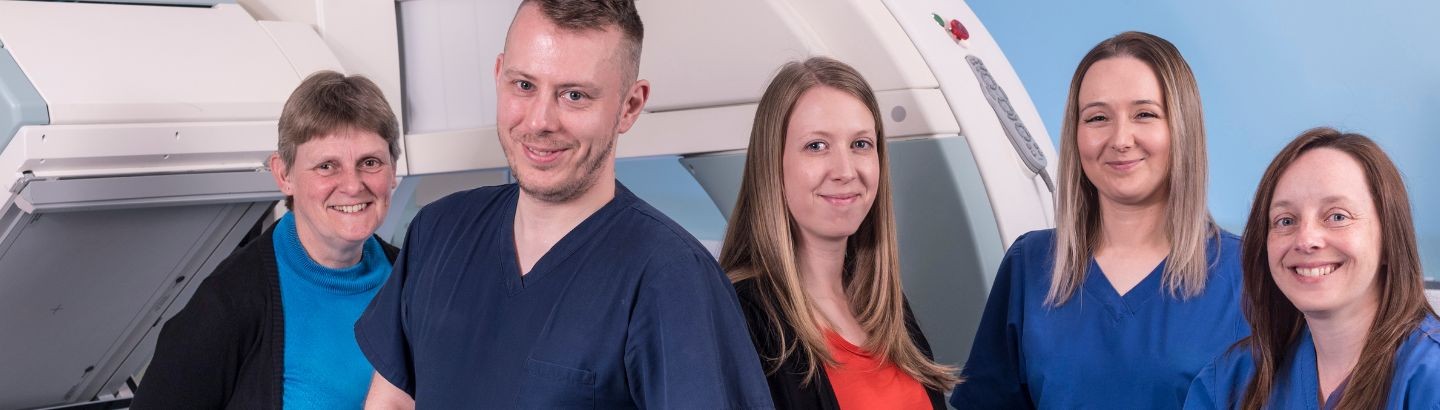
The Medical Physics team helps care for patients by providing scientific support.
The team also designs and checks medical devices that help doctors and nurses and they give expert scientific advice when needed.
What services do we provide?
A bone density scan uses low dose X-rays to see how dense (or strong) your bones are.
Bone density scans are often used to diagnose or assess your risk of osteoporosis. This is a health condition that weakens bones and makes them more likely to break.
As well as being quick and painless, a bone density scan is more effective than normal X-rays in identifying low bone density.
Nuclear medicine is a type of scan that helps doctors see how different parts of your body are working. To do this, you are given a small amount of a safe radioactive tracer. A special camera then takes pictures of how the tracer moves inside your body.
At STSFT, we have 4 general‑purpose dual‑detector gamma cameras and a dedicated cardiac gamma camera. These cameras help us take clear images of many organs, such as your heart, bones, kidneys and lungs.
These scans help your care team diagnose problems early and plan the best treatment for you. The amount of radiation used is very small, and staff will explain the test before it begins.
A vascular ultrasound is a simple and safe scan that uses sound waves to look at the blood flow in your veins and arteries. It helps doctors check for problems like blockages, narrowed vessels, or clots.
The scan does not use radiation and it should not hurt. A small handheld device is moved over your skin with gel to help create clear pictures. This test helps us understand how well your blood is moving around your body and plan the right treatment for you.
This service supports some adult patients who are having spine surgery or complex hip replacements. We use a system called intraoperative nerve monitoring, which checks nerve signals during the operation to help keep the nerves safe.
We create special systems to help doctors measure things that normal equipment can't.
We also make tools that show information in a clearer and more useful way than standard devices. Our team designs equipment that can also help patients in their daily lives.
Radiation safety is all about keeping patients, staff and visitors safe when radiation is used for tests or treatment. Our team makes sure the amount of radiation you receive is as low as possible while still giving doctors the information they need.
We check all equipment regularly, give staff the right training and follow strict national rules. Before any scan or treatment, we make sure it is the right test for you and that the benefits are greater than any risks.
Medical Physics is based at Chester Wing Outpatients at Sunderland Royal Hospital.
Use the entrance on Chester Road. We are on C level.
Our senior team in Medical Physics
Divisional director - Hannah Davidson
Directorate manager - Shauna Roberts
Matron - Julie Mills