There are many different types of treatments for Cancer, your doctor and nurse can talk through what options are available to you. The type of treatments available will depend upon
- the type of cancer that you have
- the stage of your cancer
- and your general health
Treatments for cancer can have different aims, such as
- Curative treatment, given with the aim to cure cancer
- Adjuvant treatment, given to reduce the risks of cancer recurring (coming back), adjuvant treatment is given after surgery
- Neo-adjuvant treatment, given with the aim of reducing the size of the cancer before a curative treatment such as surgery, but also with the aim to reduce the risks of cancer recurrance (coming back)
- Downstaging treatment, is given with the aim of reducing the size of the cancer enough to allow surgery to be performed
- Palliative treatment, given with the aim of controlling the cancer to reduce the symptoms of cancer, improve quality of life and help you live longer with the cancer
Please select the buttons below for more information on each type of treatment.
In order to decide what treatment is best for you, your doctor and nurse will talk to you and you will come to a 'shared decision' about the best way forward. This discussion includes
- clinical staff expert knowledge about the treatment options that are available, the evidence of what works best and the risks and benefits of treatment
- what feels right for you, such as your preferences, personal circumstances, goals in life, values and beliefs. In other words what is most important to you
Click here for useful information to help you prepare for the discussion with your hospital doctor about what treatment will be best for you and click here for useful information about consenting to treatment.
Surgery is a common treatment for cancer, there are many different types of operations from simple to more complex . Surgery can be recommended for a number of reasons
- to make a diagnosis of cancer
- to remove the cancer
- to help with the symptoms of cancer
- to prevent complications of cancer from happening
The operation that you have will depend upon your situation. Some operations are done as a day case and you don't need to stay in hospital overnight and other operations take longer to recover from and you may need to stay in hospital for a few days, your surgeon and nurse specialist will talk to you about what to expect.
If you decide that surgery is the right treatment for you, you will be given some written information about the specific operation that you are having, Your doctor or nurse will talk you through a consent form and you will be asked to sign this consent form, you will be given a copy to keep. You might want to ask your doctor or nurse
- what your surgery is for?
- how you can prepare for surgery?
- what side effects or complications could happen?
- how you will recover following surgery?
- what extra help you will need at home in the days after surgery?
Websites: https://
Videos: Prostate Cancer
Surgery
Radiotherapy is a treatment for cancer, it uses high-energy rays, such as x-rays, to treat cancer. Radiotherapy can be given for different reasons such as
- to try to cure cancer
- to try and prevent it from recurring (coming back)
- to help relieve the symptoms of cancer, for example to help with cancer pain or to reduce bleeding
Radiotherapy works by destroying cancer cells in the area where it is given. Normal cells in the area can also be damaged by radiotherapy.
- this can cause side effects
- these normal cells can usually repair themselves, but cancer cells cannot
- as the normal cells recover, the side effects usually get better
Radiotherapy is carefully planned by a team of experts to be very accurate. This means it can be used to treat the cancer more effectively, while doing as little harm as possible to normal cells.
If Radiotherapy is an option for you, you will be referred to an Oncologist (a doctor specialising in Radiotherapy and Chemotherapy). Your Oncologist will give you some written information about your treatment and talk you through a consent form, you will be asked to sign this consent form and you will be given a copy to keep.
You might want to ask your oncologist or specialist nurse
- what your Radiotherapy is aiming to do?
- how you can prepare for your Radiotherapy?
- what side effects or complications could happen?
- how you will recover following Radiotherapy?
- how long treatment will last?
- whether you will need any extra help at home during this treatment?
Patients from South Tyneside and Sunderland who need Radiotherapy are referred to Newcastle Hospitals. Your doctor and nurse work closely with staff from Newcastle as part of the MDT (multi-disciplinary team). The website (in useful links below) provides more information about Radiotherapy at Newcastle.
Click here to watch a video for some general information about Radiotherapy. Click here to watch a video from the Northern Centre for Cancer Care around your visit.
Videos:
Pelvic and abdominal side effects in men - Cancer Research UK - You Tube
General side effects of radiotherapy - Cancer Research UK -You Tube
Head and neck radiotherapy side effects - Weight loss - Cancer Research UK - You Tube
Head and neck radiotherapy side effects - Hair loss - Cancer Research UK - You Tube
Northern Radiotherapy Network Information Videos
Northern Radiotherapy Network Information Videos -You Tube
Radiotherapy for Breast Cancer and side effects following radiotherapy
Radiotherapy for Prostate Cancer and side effects following radiotherapy
Radiotherapy for head and neck cancer
Side effects following radiotherapy for head and neck cancer.
Useful links:
Northern Radiotherapy Network Leaflet -Information Videos
Radiotherapy - Newcastle Hospitals NHS Foundation Trust (newcastle-hospitals.nhs.uk)
Radiotherapy - cancer treatment and side effects - Macmillan Cancer Support
Radiotherapy | Cancer Treatment | Cancer Research UK
Chemotherapy is a treatment for cancer, it uses drugs to kill cancer cells. Chemotherapy can be given for a number of different reasons / aims such as
- to try to cure cancer
- to try and prevent it from recurring (coming back)
- to reduce the cancer as much as possible before another treatment such as surgery
- to help relieve the symptoms of cancer and improve quality of life
- to help to control the cancer so that you can live longer with it
Chemotherapy works by destroying cancer cells wherever they may be in your body. Normal cells can also damaged by chemotherapy. This can cause side effects. These normal cells can usually repair themselves, but cancer cells cannot. As the normal cells recover, the side effects usually get better.
Chemotherapy drugs are given in a number of different ways
- tablets that you swallow
- injections under the skin (sub-cutaneous injections)
- injections into a vein (intravenous). These treatments may be a short injection lasting a couple of minutes or infusions of treatments over a number of hours
- injections into your spinal fluid (intrathecal)
Most chemotherapy treatment is given as a day case in one of our chemotherapy day units at
- Sunderland Royal Hospital
- South Tyneside Hospital
- Washington Primary Care centre
Sometimes more intensive chemotherapy needs to be given as an in-patient (for some Haematology cancers), this is given on Ward B28 at Sunderland Royal Hospital.
Chemotherapy treatment may be one drug or a number of drugs given together, these drugs may be given to you on a number of occasions over a few weeks or months, but can sometimes be given over a number of years.
If Chemotherapy is an option for you, you will be referred to an Oncologist (a doctor specialising in Chemotherapy), you will be given some written information about this treatment and your Oncologist will talk you through a consent form. You will be asked to sign this consent form and you will be given a copy to keep. You will see a Chemotherapy specialist nurse who will then go into more detail about what to expect during treatment.
You might want to ask your oncologist or specialist nurse
- what your Chemotherapy is aiming to do?
- how you can prepare for your Chemotherapy?
- what side effects or complications could happen and what you should do?
- how you will recover following Chemotherapy?
- how long treatment will last?
- whether you will need any extra help at home during this treatment?
- how you will know whether the treatment is working?
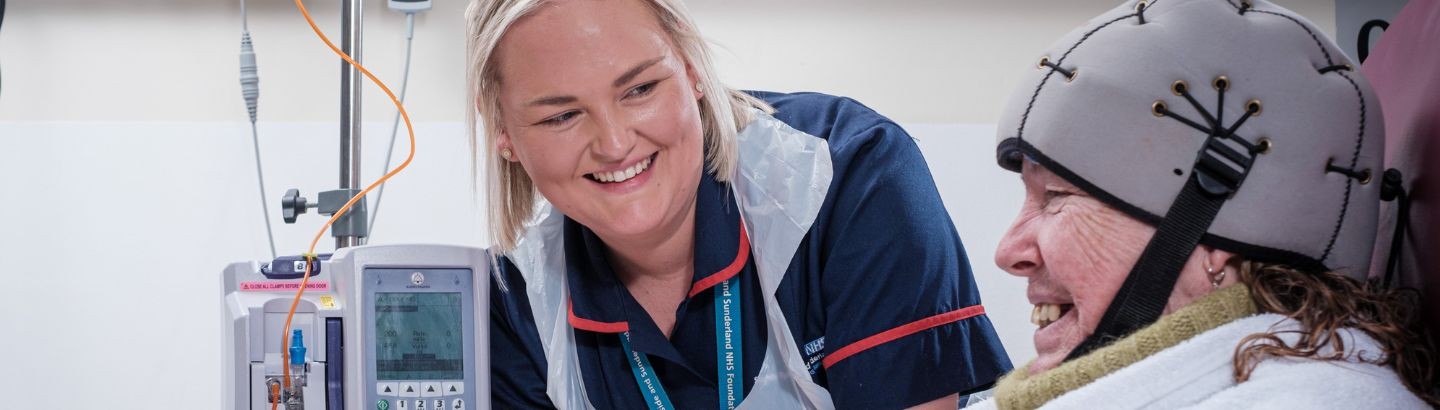
Cold cap for certain chemotherapy treatments
The cold cap treatment is offered to patients receiving certain types of chemotherapy. As most people are aware one of the main side effects of chemotherapy is hair loss, using the cold cap can help to retain your hair and is available at STSFT as well as available at the Queen Elizabeth Hospital Gateshead. Please ask your chemotherapy nurse who will be able to give you further information.
Cold cap at Gateshead Health -You Tube
Videos: These videos have been filmed by our Oncology team.
- Click here to watch a video with general information about Chemotherapy
- Click here to watch a video on treatment side effects
- Click here to watch a video showing one of the Chemotherapy unit here at South Tyneside and Sunderland NHS Foundation Trust
- Having your central line put in (BSL enabled)
Central lines: In order to give you your chemotherapy safely or if it is difficult to put a cannula into your vein your doctor or nurse may recommend a semi-permanent central line. This can stay in for a number of months while you have your chemotherapy treatment and can often be used to take blood samples also.
There are different types of Central line- Central venous catheter (often called a Hickman line)A Hickman line is a long rubber tube that is inserted into a vein in the neck and down to the large vein outside of the heart, the other end is then tunnelled under the skin and brought out onto the chest. Hickman lines are inserted by our very experienced anaesthetists in theatre. You don’t need a general anaesthetic that will put you to sleep, but local anaesthetic will be given.
- Peripherally inserted Central Catheter (PICC)A PICC line is a long that is introduced into a vein in your arm and threaded through the vein until the tip sits outside of your heart. PICC lines are inserted by a specially trained nurse or anaesthetist.
Your Hickman line or PICC needs to be cleaned and flushed regularly to keep it in good working order and we can teach you or a family member to look after your line or a District Nurse can help with this care.
Problems with your Central lineInfectionsIt is possible for an infection to develop inside your central line, if you notice any signs of an infection you should contact the telephone number given by your chemotherapy nurse or attend the Emergency department (ED). Infections in central lines are treated with infections, but if the infection does not improve sometimes we need to remove the line.Signs of an infection- Redness, swelling or heat in the area of the line- Discoloured fluid coming from the area or on the dressing- A high temperature
Blood clotsOccasionally a blood clot can develop in the vein around your central line. If this happens you will be given medication to dissolve the clot which you will need to take for a number of months, sometimes we need to remove the line if a blood clot develops.Signs of a blood clot- Swelling, redness or pain in the arm, chest or neck on the side of your body where your line is placed.- A swollen hand (on the side where your PICC line is)- Shortness of breath- Chest tightness
Break or tear in the linePlease be careful with your line and do not use scissors or anything sharp around the line. Very occasionally the line may tear or get cut, if this happens you need to clamp the line, you may be able to do this by tying a knot in the line or clamping with a clean clothes peg or something similar. You will need to contact the telephone number given by your chemotherapy nurse and your line will need to be removed.
Line fallen outVery occasionally the line may fall out. If this occurs you don’t need to worry, the vein itself will close quickly you just need to apply some pressure to the skin where your line was to stop any bleeding. If the bleeding does not stop after 10 mins you will need to contact the telephone number given by your chemotherapy nurse. In the unlikely event of a lot of bleeding you would need to attend the emergency department (ED)Please inform your chemotherapy nurse that you line has fallen out.
This website provides some more information about central lines and a video explaining what a line is and how this is inserted.
This website provides some more information about PICC lines and a video explaining what a line is and how this is inserted.
Useful links: These websites provide more information about Chemotherapy treatment
- Chemotherapy | Cancer in general | Cancer Research UK
- Chemotherapy - types, treatment plan, side effects, recovery - Macmillan Cancer Support
- Click here for information on your specific chemotherapy treatment or regimen
Booklets/Leaflets
- Understanding chemotherapy
- Side effects of cancer treatment booklet
- Side effects from chemotherapy easy read
- Chemotherapy easy read booklet
- Extravasation
- Body image and cancer
- Hair loss
Immunotherapy is a treatment for cancer, your own immune system is helped to recognise and kill cancer cells itself. Immunotherapy is sometimes given on its own or alongside other cancer treatments such as chemotherapy.
Immunotherapy isnt suitable for all cancers and more research is continuing to further develop this type of treatment.
Before starting immunotherapy treatment, your doctors will often recommend further tests to be performed on your cancer (often on the biopsy taken or the cancer removed during surgery). This can help understand if immunotherapy is likely to work.
There are a number of different types of Immunotherapy
- monoclonal antibodies
- checkpoint inhibitors
- vaccines
- cytokines
- CAR-T cell therapy
You might want to ask your oncologist or specialist nurse
- what your Immunotherapy is aiming to do?
- how you can prepare for your Immunotherapy?
- what side effects or complications could happen and what you should do about any side effects that you get?
- how you will recover following Immunotherapy?
- how long treatment will last?
- whether you will need any extra help at home during this treatment?
- how you will know whether treatment is working?
Videos: These videos have been filmed by our Oncology team.
- Click here to watch a video with general information about immunotherapy
- Click here to watch a video about how your oncology team can support you throughout your treatment
- Click here to watch a video showing one of the Chemotherapy unit where immunotherapy is given here at South Tyneside and Sunderland Foundation Trust
Useful links: More information about immunotherapy is available on these websites
- What is immunotherapy| Cancer Research UK
- Immunotherapy for cancer - types of drugs and side effects - Macmillan Cancer Support
- Immunotherapy | Macmillan Cancer Support
- Atezolizumab | Macmillan Cancer Support
- Pembrolizumab | Macmillan Cancer Support
- Nivolumab (Opdivo®) | Macmillan Cancer Support
- Lenalidomide (Revlimid®) | Macmillan Cancer Support
- Ipilimumab | Macmillan Cancer Support
CAR-T: CAR-T therapy (chimeric antigen receptor T Cell therapy) is an individualised treatment, aiming to reprogramme a persons immune system to target their cancer.
It is currently available only for specific haematological cancers, where it has been shown to work. The treatment is highly complex and involves several steps over a number of weeks.
Currently patients who are offered this treatment have had previous unsuccessful treatments for Acute Lymphoblastic leukaemia or diffuse large B cell lymphoma. A multi-disciplinary team (MDT) of professionals will determine if this treatment is likely to benefit you.
Patients from South Tyneside and Sunderland are referred to Newcastle where CAR-T therapy is given by an expert group of clinicians based at Freeman Hospital. After CAR-T your further care is provided by Sunderland Royal Hospital.
Click here for more information about CAR-T.
Scientists are constantly learning more about cancer and how to treat it through research. Patients are often invited to take part in clinical trials to help with research.
There are different types of clinical trials
- observational trials, where patients are observed to find out what happens in different situations. This may involve for example, check-ups with your doctor, questionaires or blood sampling
- interventional trials, where different types of treatment are researched for example, surgical, chemotherapy or radiotherapy. Interventional clinical trials are used to test how well a new treatment works
Interventional clinical trials are designed to understand
- whether new treatments work better than standard treatments
- whether different combinations of drugs work better
- what side effects of treatments patients experience
Early phase clinical trials using the newest of treatments are carried out locally at Newcastle in the Sir Bobby Robson Clinical trials unit. These trials are generally used when patients have recieved other treatment options available to them.
You may wish to ask your cancer doctor or specialist nurse if there are any clinical trials that would be suitable for you to take part in.
Click here to watch a video from a member of our cancer research team
Useful links: These links to websites provide some more information about clinical trials
Radio-Iodine is used to treat Thyroid Cancer, it not used to treat any other cancer. This treatment is called Radio-Iodine AblationThis treatment is used to destroy any remaining normal thyroid tissues or microscopic thyroid cancer, whilst also reducing the risk of the cancer returning. Most patients will be admitted, but for a small proportion, who are having a lower dose of treatment, you may be able to stay at home.
Radio-Iodine Treatment
- is given after you have had your thyroid surgically removed
- is given in capsule form, which you swallow
- is given at Freeman hospital in Newcastle
- you will be admitted to hospital in the Radiation suite, this is a precaution to prevent other people being exposed to the radiation
- the radiation leaves your body by body fluids such as urine and faeces (poo)
- the radiation level decreases very quickly
Click here to watch a video from our teams about Thyroid.
Useful links:
- Treatment - Butterfly Thyroid Cancer Trust
- Preparing for radioactive iodine treatment
- Northern Centre for Cancer Care
- Thyroid Cancer Iodine Treatment Suite
- Low Iodine Diet
- Understanding Thyroid Cancer
Stereotactic Ablative Radiotherapy (SABR) is a very specific type of Radiotherapy. Many smaller beams of radiotherapy are directed to the cancer from many different angles. This means that the cancer itself gets a large dose of radiotherapy but healthy tissues around the cancer recieve only a lower dose reducing the risk of tissue damage.
You might want to ask your oncologist or specialist nurse
- what your SABR treatment is aiming to do?
- how you can prepare for your SABR treatment?
- what side effects or complications could happen?
- how you will recover following SABR treatment?
- how long treatment will last?
- whether you will need any extra help at home during this treatment?
Click here to watch a video from our oncology team about SABR treatment
Useful links:
Radiotherapy - Newcastle Hospitals NHS Foundation Trust (newcastle-hospitals.nhs.uk)
Some cancers use your bodies natural hormones to help them grow. Using medications that can alter your hormones or block how cancers use your hormones can prevent the cancer from growing.
Some specific cancers can be treated using hormones
- Prostate cancer
- Breast cancer
- Ovarian cancer
- Endometrial (womb) cancer
Hormone manipulation treatment is often given over long periods of time as tablets or injections.
For many patients the side effects of these medications are minimal, but for others side effects can have an impact upon quality of life. If you are struggling to take this medication please discuss with your cancer doctor or specialist nurse how to better manage these side effects or any alternative treatment options.
Useful links:
Bone marrow or stem cell transplants are sometimes used in the treatment of Haematology cancers such as
- Leukaemia
- Lymphoma
- Myeloma
Stem cells are the very early cells in the bone marrow that develop into blood cells
Transplants can be performed using
- Your own stem cells or bone marrow. This allows high intensity chemotherapy to be given to you before your own stem cells are given back to you.
- Stem cells from a donor (someone else) either using a close relative or a matched unrelated donor.
Locally, transplants are performed at Newcastle hospital with the team at Sunderland Royal Hospital looking after you in your recovery. Having a bone marrow or stem cell transplant involves having a long stay in hospital, you might want to ask your cancer doctor or specialist nurse
- what your transplant is aiming to do?
- how you can prepare for your transplant and what you might need for your stay in hospital?
- what side effects or complications could happen and what can be done?
- how you will recover following your transplant?
Bone marrow transplants using your own stem cells will involve a shared care agreement with Sunderland Royal Hospital and Freeman Hospital Newcastle. You will stay in both hospitals.
Bone marrow transplants using somebody else’s stem cells will be performed at Newcastle Freeman hospital and you will stay at Freeman hospital and receive follow up care at Freeman hospital.
Prior to any type of bone marrow transplant, you will have an appointment to meet the transplant team at Newcastle and discuss your care in detail.
Click here for more information about bone marrow and stem cell transplants.
Useful links:
Anthony Nolan - What we do
Understanding stem cell transplants
Preparing for a stem cell transplant
Bone strengthening treatments such as Bisphosphonate medication is often used as a cancer treatment, these medications include
Bisphosphonate
- Zoledronic Acid (often called Zometa)
- Pamidronate
Monoclonal anti-body
- Denosumab
These are medications commonly used to treat osteoporosis (bone thining) but they also used as a cancer treatment, uses in cancer include
- to strengthen bones where bone metastases may cause bones to become weaker, this treatment aims to reduce the risk of bone fractures
- to reduce bone pain linked to bone metastases
- to manage and prevent high calcium levels in the blood which can happen with some forms of cancer
- to reduce the risk of cancer recurrance in the bones
These bone strengthening treatments can be given in tablet form but is most often given as an injection under the skin or as a short intravenous (into a vein) infusion.
Side effects of bone strengthening treatments are usually mild and short lasting, but include
- bone pains
- flu-like symptoms
- reduced calcium levels - you may be asked to take calcium supplements to help with this
- constipation or diarrhoea
- tiredness
ONJ
One further side effect of this type of medication is a problem with the jaw called ONJ (osteo-necrosis of the jaw). This is not a common problem occuring in up to 2% of patients recieving this treatment. ONJ can cause pain in the jaw and wound healing problems in this area.
We would encourage you to have regular dental check ups and look after your teeth whilst on this medication. If you do need any dental procedures such as a tooth removal while on this medication please make sure your dentist knows that you are taking this medication and ask your cancer nurse for advice. We may advice you to stop your bone strengthening for a short time while you have your dental work completed.
Click here for more information on dental hygiene.
Useful links:
Bisphosphonates | Cancer Research UK
Jaw problems (osteonecrosis) and cancer treatment | Cancer Research UK