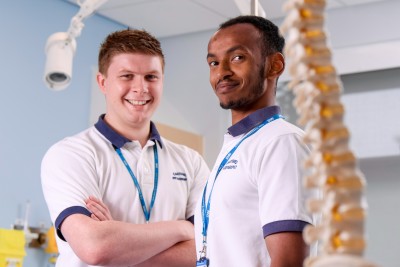
Sunderland Integrated Musculoskeletal Service (SIMS) is a team of skilled health professionals who work together to help people with muscle, bone and joint problems.
Our team includes:
- A Consultant in Sports and Exercise Medicine
- GPs who have a special interest in MSK care
- Extended Scope Practitioners (specialist physiotherapists with extra skills, such as using scans and giving injections)
- Specialist MSK Physiotherapists
- Technical Instructors who support physiotherapy and help guide people with exercise and rehabilitation
What conditions do we treat?
Achilles tendinopathy (often called tendonitis, although this is not fully correct) is a condition that causes pain and discomfort in the Achilles tendon. The Achilles tendon links the calf muscles in your lower leg to your heel bone.
People used to think this problem was caused by inflammation. However, it is now believed that inflammation is not the main cause. Instead, the tendon becomes painful due to wear and tear over time.
Sometimes this knee pain can be caused by changes in the structure of the knee. However, it can also happen even when the knee is normal. Everyday activities and the loads we put on the knee can still cause pain without any injury.
Anterior knee pain is one of the most common knee problems. It makes up almost 25% of all knee issues in adults. The pain is usually not linked to damage inside the knee, and there is often no serious problem found. Even so, it can still be very upsetting and can make it hard to do daily activities such as climbing stairs, walking or playing sports.
Carpal tunnel syndrome (CTS) is pressure on a nerve in your wrist. It causes tingling, numbness and pain in your hand and fingers. You can often treat it yourself, but it can take months to get better.
Osteoarthritis is the most common type of arthritis. It affects about 8.5 million people in the UK. It develops slowly over time and can make your joints stiff and painful.
When osteoarthritis affects the hip, it often causes pain in the front of your groin. Some people may also feel pain in the side or front of the thigh, in the buttock or even down to the knee.
Your knee is a hinge joint. It has smooth cartilage on the ends of the bones to help it bend and straighten without friction. The knee also has another type of cartilage called the meniscus, which helps cushion and support the joint.
Osteoarthritis is a normal “wear and tear” process that develops over many years. Being active in sports, having past injuries, or having knee operations can make someone more likely to develop this type of arthritis later in life.
Lateral hip pain used to be called trochanteric bursitis. People once thought the pain came from an inflamed bursa (a small fluid‑filled sac) on the outside of the hip. We now know this is not very common.
Most of the time, the pain actually comes from the muscles and tendons on the outside of the hip.
The main symptom is pain on the outside of the upper thigh. Lying on the painful side in bed often makes it worse. Walking can also be uncomfortable at times.
This condition often gets better on its own over time. But some people may need anti‑inflammatory painkillers, strengthening exercises, or sometimes a steroid injection to help with symptoms.
Back pain is very common. Around 8 out of 10 people in the UK will have back pain at some point in their lives.
There are many reasons why back pain happens, and it can affect people of any age. Although it can feel very painful and inconvenient, it is reassuring to know that most back pain improves within 6–8 weeks.
In most cases, people with back pain do not need to see a physiotherapist. Staying active and using over‑the‑counter painkillers is often enough for the pain to settle. However, if the pain is severe or does not improve, you should seek medical advice for further support and treatment.
Chronic neck pain means neck pain that lasts for at least three months. Like short‑term (acute) neck pain, it often begins with a strain or a sudden flare‑up. But instead of improving with exercises, time and advice, the pain lasts much longer and can have a big effect on your daily life.
In most cases, the neck will still improve on its own. However, treatments such as physiotherapy, exercise, and medication may help your recovery. It is very important to stay active and try to continue with normal daily activities. But if the pain is severe or does not improve, you should seek medical advice and have your symptoms assessed.
The rotator cuff is a group of muscles in the shoulder that help keep the shoulder joint stable and moving smoothly.
The rotator cuff helps control shoulder movements when you do everyday tasks such as lifting your arm, reaching overhead or carrying objects.
When these muscles or their tendons are not working well, you may feel pain in your shoulder or in the upper arm above the elbow.
Rotator cuff pain is the most common cause of shoulder pain.
Tennis elbow is also called lateral epicondylitis or lateral elbow pain. It is one of the most common reasons for pain on the outside of the elbow. It affects the common extensor tendon in the forearm. This tendon helps keep the wrist steady when you grip objects or use your hands.
Tennis elbow can happen at any age, but it is most common in people aged 40 to 60, and it affects men and women equally.
The condition is usually caused by overusing the muscles and tendons around the elbow.