
Published on: 22 December 2025
The new Eye Hospital in Sunderland is preparing to set a national benchmark for patient-centred sight loss support when it opens in summer 2026.
As the number of people in the UK living with sight loss is expected to double by 2050, the hospital will play a vital role in supporting patients diagnosed with conditions that can lead to sight loss, such as glaucoma and macular degeneration.
Thanks to a partnership between leading sight loss charity The Royal National Institute of Blind People (RNIB) and South Tyneside and Sunderland NHS Foundation Trust (STSFT), patients will benefit from life-changing support at every stage of their eye care journey.
Two Eye Care Liaison Officers (ECLOs), appointed by RNIB in partnership with STSFT, already support hundreds of patients with all types of eye conditions at the current Sunderland Eye Infirmary. Patients benefit from their help in making sense of their diagnoses, receiving emotional care and access to vital support and information.
They also assist patients in accessing financial support and adaptive technology, while empowering them with practical skills for independent living after sight loss. They are a vital point of contact and support for patients’ families and carers.
Sunderland ECLOs, Mary Hall and Jo Hewitson are both registered Severely Sight Impaired, giving them a unique understanding of the challenges of sight loss and the resilience needed to move forward and thrive.

At the new Eye Hospital, they will operate from a bright, purpose-built room located at the front of the building, designed for easy access and visibility.
Mary brings more than four years of experience as an ECLO, having spent the last two and a half years at the current hospital. She shared:
“I was born with sight loss and I felt becoming an ECLO was an opportunity to put my skills and experience into practice. It is so important for patients, members of their family and carers to have practical and emotional support when they are diagnosed.
“I was born in the late 1960s and registered Severely Sight Impaired at a time when little support was available for my parents. Today, patients who receive difficult news in an appointment can turn to us for guidance, helping them process it and ensuring they never feel alone on their eye care journey.
“To have that shared lived experience with a patient, you can feel that mood lifting in the room for them. I have patients saying, ‘it’s amazing because you understand what I’m saying, you get what I’m going through, you know how it feels.’
“We have sight loss and can’t change that, but we can change how we perceive ourselves and move forward with our lives and make the best of whatever we want to do, whatever goals or aims we aspire to.”
Jo Hewitson also has sight loss and a professional background in psychology. She said:
“I was diagnosed at Sunderland Eye Infirmary where luckily there was an ECLO at the time. Now, to be part of that service, having received the amazing support back then is a great feeling.
“Without the ECLO service patients might not be aware of the support available to them and might not be clear about how to find a way forward after they’ve been diagnosed. My favourite moment of the job is when there’s a lightbulb moment in the room and patients realise, they are not on their own.”
Cathie Burke, RNIB’s practice lead for Eye Care Support Services previously worked as an ECLO herself at Sunderland for 17 years. She said:
“I am super optimistic about this. In the current hospital, the ECLO rooms are hidden away at the back, not branded or obvious to patients. In the new hospital we’ll be right by the welcome desk on the left as you walk through the front door. It will be a showcase for what ECLO services could be like everywhere.
“The biggest opportunity here is for patients to self-refer to an ECLO. The offer of practical and emotional support will be there right in front of people. Volunteers on the welcome desks will also be able to refer patients for ECLO support.”
The ECLO room at the new Eye Hospital will be fitted out with high-contrast colours, a comfortable seating area and colourful RNIB branding and messaging. This dedicated space will offer patients and families a quiet setting to talk through diagnoses, treatment or sight loss and access tailored support to help.
RNIB has been closely involved in the hospital’s planning from the outset, applying its Visibly Spaces Principles on layout, visibility and lighting to ensure the building is fully accessible.
Beyond the ECLO service, RNIB has worked to make the hospital the best possible environment for blind and partially sighted people. This has involved organising patient focus groups to shape the design and making sure their voices were heard throughout the process.
Sunderland has long been recognised for delivering outstanding eye care, and the new hospital will continue this tradition in a far more comfortable and patient‑friendly environment. For instance, Sunderland Eye Infirmary was built when it was deemed that sunlight was vital to your recovery, so all the rooms had big windows and faced the sun.
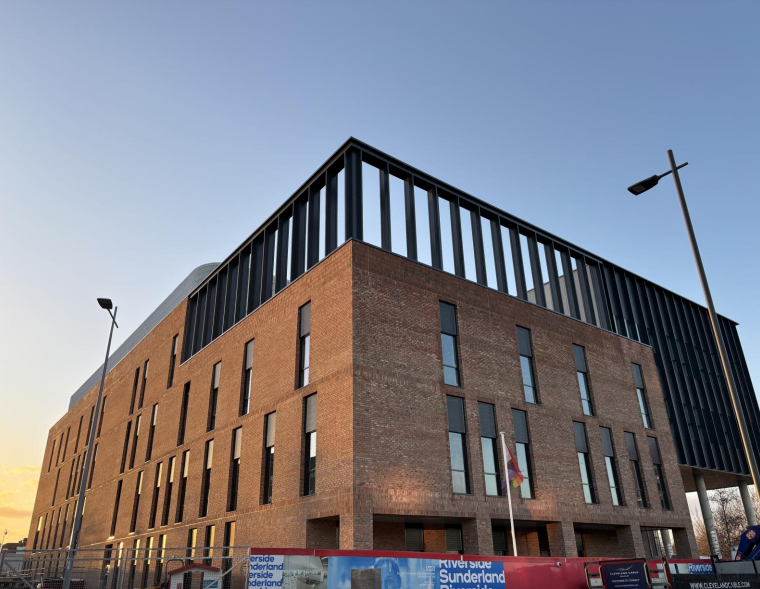
The new hospital has been built the opposite way round with much more attention on the size and location of the windows to minimise discomfort for patients who often experience problems with glare.
Accessibility will also be improved through better transport links, with the hospital located closer to Sunderland’s bus and train hub, making it easier for patients across the region to reach the care they need.
For more information about RNIB’s ECLO service visit https://www.rnib.org.uk/your-eyes/navigating-sight-loss/eye-care-services-and-roles/eye-care-liaison-officers-eclos/
For more information on South Tyneside and Sunderland NHS Foundation Trust: www.stsft.nhs.uk


