
Published on: 10 April 2026
From Wearside to world-wide, experts who help save the eyesight of patients across the North East are using their skills to help make a difference internationally.
Consultants at Sunderland Eye Infirmary (SEI) have taken time out from their busy NHS roles to support people with eye problems around the world. In turn, they have brought back learning to help local teams as they develop their careers.
In addition to training and educating others around the world, they have helped those most in need of care and furthered international research and connections.
Sunderland already has a global reputation for eye care and is a member of the World Association of Eye Hospitals (WAEH). This works to improve the experience, care and outcomes of patients who have eye disorders. It also exchanges knowledge and the best ways to plan and organise care.
Sunderland’s expert team of eye specialists will build on the city’s international reputation when they move to the region’s new Eye Hospital in Sunderland city centre this summer.
The new Eye Hospital will see all services based at SEI in Queen Alexandra Road and led by South Tyneside and Sunderland NHS Foundation Trust (STSFT), transfer to the purpose-built hospital on the Riverside Sunderland site.
Ajay Kotagiri is the Clinical Director of Eye Services at STSFT. He has previously travelled to Hong Kong to work alongside its specialists to share learning.
He said:
"Our teams at Sunderland Eye Infirmary are dedicated to learning and sharing.
"A number of our consultants have taken up opportunities to share their expertise around the world and volunteer their support to those in need. They bring those experiences back with them and it strengthens what we do.
"As a service, we have many colleagues who have started their careers abroad, graduated in different countries and also taken up further training here in the UK. We are very proud of our global reputation for the treatment we offer our patients.
"These doctors have not only used their knowledge and expertise to treat those desperately in need, but invested their own time to support their peers so they can continue this work to save the eyesight of patients.
"We are very proud of this. Alongside the many international research studies we are part of, this helps put our name on the global map of specialist eye hospitals."
Among the consultants who have supported international projects are Maged Habib and Karim El-Assal. They are Consultant Ophthalmologists at SEI. Mr El-Assal specialises in glaucoma. Mr Habib is also a Vitreoretinal Surgeon. This specialises in delicate surgery on the back of the eye using tiny instruments to fix serious problems like retinal detachment, macular holes, or damage from diabetes.

Mr Maged Habib, left, with ophthalmic trainees from Copts in Need.
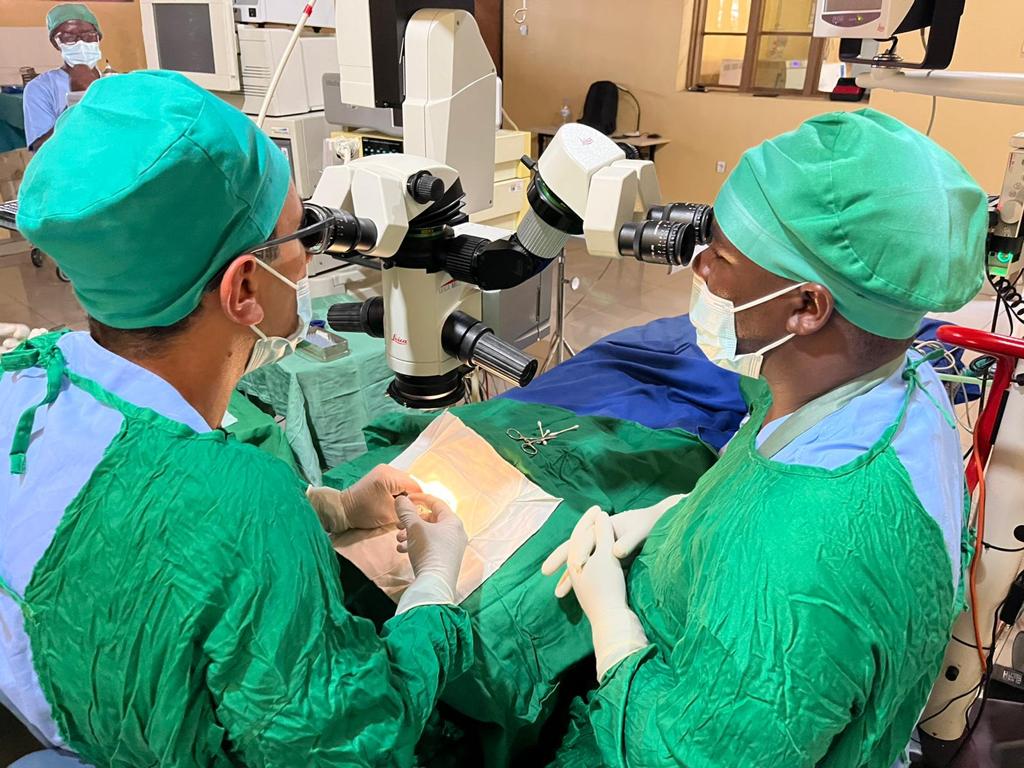
Mr Karim El-Assal, left, operates on a patient.
Both have worked with Copts in Need (CIN), a UK-registered charity. The non-profitable charity aims to support people living in the most deprived areas of Egypt where there are a high number of people with visual impairments, blindness and untreated cataract and eye diseases.
Later this year they will support work in Nairobi in Kenya to help its deprived communities.
Ms Jia Ng, who specialises in Glaucoma, and Mr Lawrence Gnanaraj, a Paediatric Ophthalmologist and the Trust’s Associate Medical Director, have also shared their expertise to colleagues at Kabgayi Eye Hospital in Rwanda. They trained doctors to perform glaucoma surgery and squint surgery.

Ms Jia Ng pictured as she carried out treatment on a visit to Rwanda.

Mr Lawrence Gnanaraj treating a patient on one of his international trips.
Mr Gnanaraj also supports Lifeline Express, which offers cataract surgery for underprivileged patients in mainland China. It also helps train specialists and he has helped support those who care for babies to boost their skills. His next visit will be later this year.
Professor David Steel is a Consultant Ophthalmologist and Vitreoretinal Surgeon. He has collaborated internationally with research projects across Europe, Asia, Australia and China. This includes looking at how Artificial Intelligence (AI) can help treat retinal disease, experimental surgery and improvements to eye operating procedures. He has attended the South African Combretum, a meeting where he has shared his knowledge with other retinal surgeons.

Professor David Steel, front row and centre, on his visit to the South African Combretum.
Most recently, Prof Steel was confirmed as the Co-Director of NORI, a new multi-million-pound research institute announced at the end of last year in partnership with the University of Sunderland and STSFT.
The £4.2million Northern Ophthalmic Research and Innovation Institute (NORI) will be based at the University, close to the region’s new Eye Hospital in Sunderland, helping transform the detection and prevention of eye disease. It will create a world-leading joined-up data centre to help researchers and doctors understand who may be at higher risk of certain illnesses and how diseases develop over time.
More details about the region’s new Eye Hospital can be found through this page: New Eye Hospital. Information about the Trust’s research work is available through this page: Research


